SUBMARINE
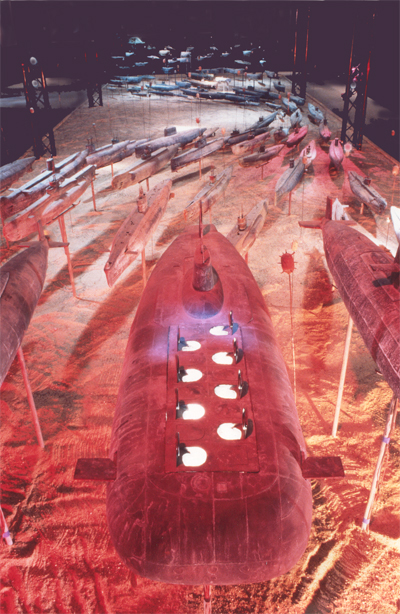
Submarine Exhibition (1990, Glasgow City of Culture)
The first and most ancient purpose of art was to visualise the invisible, gods the souls of ancestors, spirits, powers felt but unseen. Mythology was an integral part of this purpose, creating a working hypothesis by which mankind could touch, appease and understand things he feared or desired. In a parody to theses ancient purposes, I have called upon my shipyard experiences to create 'Submarine'. A temple to man's quest for 'invisibility.
Aesthetics have always been part of weapon making. From the moment man became tool maker he felt the need to embellish. The stone-age axe, shaped and smoothed beyond function need, the sculptured power of the Greek helmet, the beautiful lines of the Spitfire. Display of aggression needs aesthetics and there is something in us all that states, if it looks good it works better. Yet the submarine is the only weapon where aesthetics plays no part, it is designed not to be seen. The pursuit of invisibility has no need of art; the submarine is the aesthetic Anti-Christ.
My first contact with a submarine was in childhood, an innocent fascination shared by a generation, a Kellogg's freebie, "The Baking Soda Submarine". To ensure an adequate collection, I must have consumed at least 100 packets of cornflakes. It amuses me greatly to think I squandered a year of precious childhood watching wee bits of coloured plastic going up and down in a jar of water.
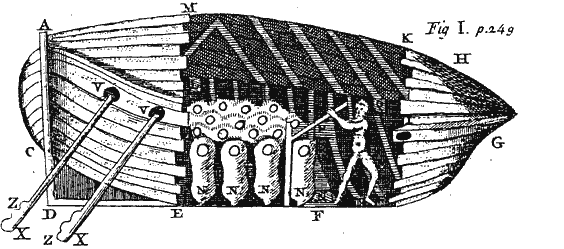
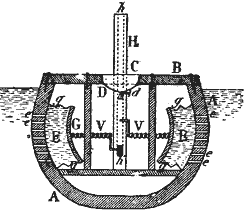
Ironically this simple toy parallels the technological difficulties that plagued the evolution of submarine design ... to sink and rise at will…or in the words of William Bourne - 16th Century submarine designer.. . "So that it may goe under water unto the bottome, and so to come up againe at your pleasure". I and million other wee souls, spent many a frustrating hour struggling to acquire this 'pleasure'. The solution being in using a certain type of lemonade bottle with a rubber seal on the cork.
 e
e
William Bourne's submarine design

John Browns Shipyard
An apprenticeship is a kind of adoption, taken into care and taken the 'Mickey out of' simultaneously. Under the wing of these grown men, my 'real' education began. Packed into this ribbon of land, one mile long by a quarter wide, were five thousand men ... five thousand lives, happy, mean, bitter, talented and any other description you could think of.
The Second World War had finished 18 years, the bulk of them had been in it somewhere. Here were real stories to fire an active mind, a vast richness of human experience. This was more real than long division and basket weaving and I was proud to be part of it. Around me were men who had, in five years. seen more than most in a lifetime, some had sailed in convoys, others in submarines. Reality dawned and my innocence faded.
Shipbuilding is a no nonsense game. It is dirty, noisy and dangerous, but it has a visual richness that you can find nowhere else. The forces used to mould ships have their own intimate beauty. Rust, red lead, fire, rivets and steel. It is the shapes and textures of this environment that dissolve into much of my work. Toiling in and around a huge mountain of red leaded steel in a hell of noise, you get to despise it all, yet there is a pride hard to match in any other industry. There is nothing to compare to the sight of 40,000 tons of formed steel slip gracefully into its element. It is a gigantic birth with all the encumbering emotions.
So much were submarines reviled and feared that, in Word War Two, the British Empire and the United States deployed nearly half of the industrial might of the word against them. In 1917 and 1942, in a deadly game of hunter and hunted, Britain was brought to within a hairs breadth of defeat by U boats. In the seas that surround us lie twenty-five and a half million tons of sunk ships as testimony.
It is a cruel twist that a weapon of such magnitude should be so vulnerable. Tracked and caught the submarine is defenseless, any weakness brutally punished by the element in which it hides. In the oceans lie the remains of over one thousand submarines - British, Russian, Japanese, German, Italian, French, Polish and American - sunk, some with all hands.
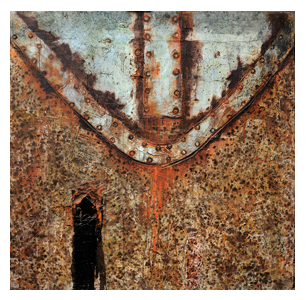
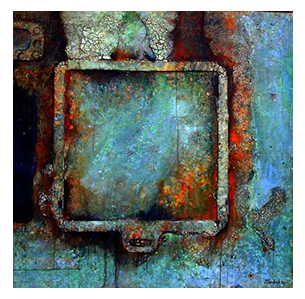
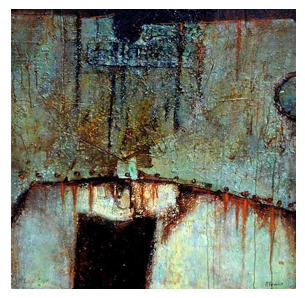
Three examples from the Corroded Panels series of paintings. Mixed media 120cm x 120cm
As an artist, I am motivated by creation, but I am drawn by a fascination for destruction. I find ironical that the sea, which gave life to earth, should now harbour in its depths the deadliest and most destructive weapon in the history of mankind. I am attracted by its power, brutality and vulnerability, but perhaps most of all its ugliness. This is the story of the ugly duckling that turned into the hideous monster.
The submarine has an evolutionary history resembling a bizarre black comedy pockmarked with disasters and lost lives. Sacrifices in the pursuit of a workable technology. I can think of no other machine which provokes such a wide range of emotions in human beings, most of all fear. Do we fear the submarine because it stirs something dark in all of us? Does ft reveal, by its methods, things deep and disturbing in the psyche of mankind?
In this
mythological deep sea world lies the 'Grave of the Undersea Boats'.
Above a sand covered floor, bathed in the reflection of a shimmering sea.
Here
are the spirits of submarines gone, represented in every shape and
form, the Kaiten, Japanese suicide torpedoes, U-boats
, British T. V, S and U classes. Russian, Italian Midget submarines. Spanning time, the American Civil War Huntley's and David's and submarines from the 16th century. At
the head of this shoal, the final stage of evolution, sits the 'God
Submarine', on each side it has hunter killer guardians. It purpose is to guide the spirits
of its ancestors through the minefields. The God Submarine faces the
clock of invisibility, which has no hands to tell time. The submarines are blind and count
the seconds to Armageddon by the sound and motion of a swinging pendulum.

Stills from the documentary 'Submarine'
Click For Film Preview
On dark walls hang remnants of past happenings. Ghosts of Dead Ships, eroded panels, sea corroded steel, dissolving rivets and weeping bulkheads, The outlines of decks and hatches draw detail and hint at human activity. In the background a barely audible sound track. The dull rhythmic throb of heavy diesel engines, fleeting whispers of lost crews. There is a mood change, the hunter, the paths of passing ships, deeper and deeper and as the blue darkens, hulls groan, tortured by the crushing forces of an oppressive sea. Hushed gurgles as a different cargo of death descends, an eerie silence is ruptured by conclusive explosions. A tense damp claustrophobic stillness pierced by echoing drips from fractured pipes.
All these things are sent to haunt the crews of the undersea boats. Encased in their steel coffins, they await their day of judgment. "Were they murderers or war criminals who committed appalling atrocities, deserving hatred among victims? Or were they professional sailors who courageously battled against fearsome odds in a foul environment of stale squalor, sweat and poisonous diesel fumes, where day and night blurred and death by drowning, asphyxiation or explosion was ever present? "
Tom McKendrick 1990