IRON
zA superb show by Tom McKendrick
mourns, celebrates and explores
Glasgow's great shipbuilding past, by
lain Gale.
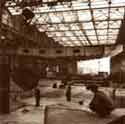
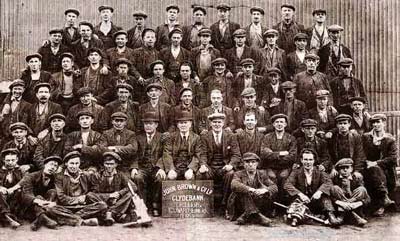
Without a hint of contrivance, McKendrick has transformed the exhibition space into a temple to the rivet gods of the Clyde. And he is well qualified to do so. Born in Clydebank in 1948, McKendrick became an apprentice in John Brown's shipyard at the age of 15. The tale he tells of the reality of that existence is bound to strike home with his fellow ex-employees. It may reduce some to tears. Even Hard Men sometimes cry.
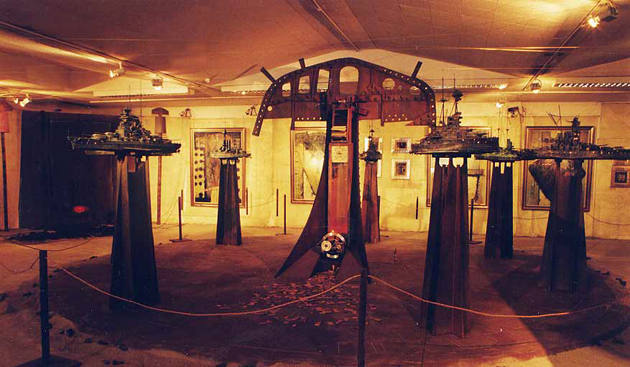
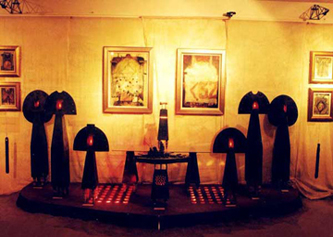
To the doleful accompaniment of a soundtrack of hammer blows, accordions, Bagpipes and muttered oaths, especially composed by Alasdair Fleming, we enter. McKendrick's temple. Before us sits The Great Timekeeper - an endlessly ticking pendulum around which seven model dreadnoughts have been placed - perhaps in supplication. In the carefully engineered half light of the gallery the immediate-effect is overwhelmingly devotional. But resist the temptation to kneel.
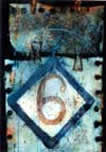
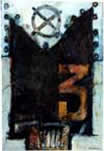
 Turn to the walls,
around which the artist has are arranged his side chapels. Here
are the altars of the Clydeside religion presented as archaeological
artefact we are gazing on the vanished gods of a lost civilisation
and the simile does not end there. McKendrick
explains, Iron is fundamental to man's existence. God like it fell from
the sky the product of a supernova to be discovered by man in the first
Ion Age. But what we are looking at is Mckendrick homage to the people
of the second Iron Age. Of course, it's not an entirely original idea.
Returning to Glasgow in the 1940s, the colourist J D Ferguson saw the
giant ships in religious terms. They were, he said cathedrals of the Clyde.
Ferguson however, unlike McKendrick, never had the temerity to realise
his vision.
Turn to the walls,
around which the artist has are arranged his side chapels. Here
are the altars of the Clydeside religion presented as archaeological
artefact we are gazing on the vanished gods of a lost civilisation
and the simile does not end there. McKendrick
explains, Iron is fundamental to man's existence. God like it fell from
the sky the product of a supernova to be discovered by man in the first
Ion Age. But what we are looking at is Mckendrick homage to the people
of the second Iron Age. Of course, it's not an entirely original idea.
Returning to Glasgow in the 1940s, the colourist J D Ferguson saw the
giant ships in religious terms. They were, he said cathedrals of the Clyde.
Ferguson however, unlike McKendrick, never had the temerity to realise
his vision.
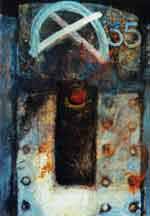
Like Ferguson before him he sees the heavy industry of the Clyde as the natural repository of the innate Ceilticism of the exiled Highlandman. In these powerful images of tribal faith, Ossian has been formed into a "patter-merchant" and then re-imagined in the visual language of another, simpler age. All this is captivating enough. But what lifts this exhibition above the ordinary, what gives it the power to be a landmark event in Glasgow's cultural history, is the secondary level onto which McKendrick now transports his audience. Interspersed around the walls, at intervals between and behind the altars, are paintings - richly encrusted, semi- abstract canvases which relate directly to the three-dimensional tableaux before them. Such is their power and presence that they would on their own have made an impressive and evocative shows.
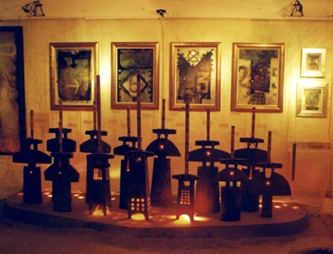
Now, in the temporary cathedral of the Collins Gallery, McKendrick's altars define the seven sects of the great religion. Totemic high priests jealously guard not only the altars but also the skills of their own learning - their trades - passed down as arcane wisdom through the generations. At the Altar of the Sacred Hammer, 12 such guardians keep watch.
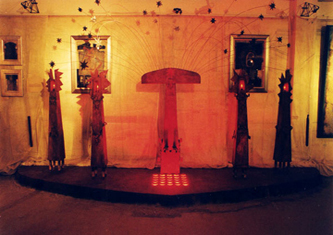
0pposite flicker the electric candle- lit faces of a similar group around the Altar of the Great Spark. Here too are the keepers of the Rivet Tool Altar and over those who watch over the Altar of the Golden Rivet - that elusive Holy Grail believed by the riveter to lie hidden among the millions of rivets in every truly great structure. Behind the altars glow two furnaces, bathed in red-hot light. Their significance is not lost on McKendrick, as echoes of another religion - the Calvinist heritage of the shipyard worker.
As McKendrick himself has explained, in the closed society of the shipyard, the workers created their own mythology in which demigods from the Gorbals perpetrated feats of Herculean proportions. Their legends were perpetuated by word of mouth in a storytelling tradition, which mimicked that of their ancestors. sMckendrick has made the equation that so many of his fellow shipbuilders were essentially- transplanted Highlanders.
The social realism of Howason and Currie and the political witticisms of George Wylie are now quite familiar. McKendrick however, seems closer in feeling to Bet Lows industrial ima ges of the 1940s and ultimately to Williarn Bell Scott's celebratory 1861 painting, Iron and Coal. Taken with the primordial forms of his sculptures, these paintings suggest that McKendrick is also looking to more universal notions which have informed the art of our century - the Jungian symbolism of Emst, Davie and Paolozzi. In the way in which the art of Will Maclean addresses the Highlands, McKendrick has given Clydeside back its true identity. Like Maclean he also points the way towards the greater goal of a genuine renaissance for the cultural identity of Scotland as a whole.
If they have not already done so, Messrs Lally and Spalding should hurry along to the Collins Gallery, cheque book in hand, for if anything deserves to be in their new Gallery of Modern Art...it is IRON...in its entirety or at least in part."What we would like to see", wrote Ferguson in his 1943 book Modern Scottish Painting "is art in the same class as the Queen Elizabeth." Look no further.